Mostrando entradas con la etiqueta Z. Mostrar todas las entradas

sábado, 7 de septiembre de 2013

Power and Policy in Syria - Radwan Ziadeh


In an unstable Middle East, beset by regional tensions and repercussions of the global war on terror, Syria is a key player. The bloodless coup by General Hafez al-Assad, in 1970, put in place a powerful autocratic machinery at the core of the state which continues till today under the control of his son Bashar. Here Radwan Ziadeh presents a fresh and penetrating analysis of Syria’s political structure -- a "despotic" state monopoly, a bureaucratic climate marked by fear, and the administrative structure through which centralized control is exercised. With a focus on Syria’s intelligence services which have significant influence in legal and policy decisions, and the conditions and patterns of foreign policy decision-making, particularly vis-à-vis the US, Power and Policy in Syria is essential reading for all those interested in Syria, the modern Middle East, International Relations and Security Studies.


lunes, 10 de septiembre de 2012

Against Civilization Readings and Reflexion, John Zerzan

Compendio de artículos de distintos autores en los que se trata el tema de la crítica a la civilización, editor y compilación por John Zerzan.
Descarga aquí.

lunes, 4 de junio de 2012

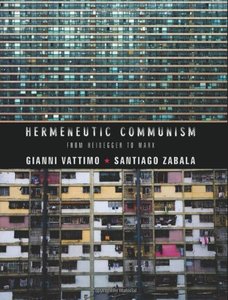
Hermeneutic Communism: From Heidegger to Marx - Gianni Vattimo & Santiago Zabala


Having lost much of its political clout and theoretical power, communism no longer represents an appealing alternative to capitalism. In its original Marxist formulation, communism promised an ideal of development, but only through a logic of war, and while a number of reformist governments still promote this ideology, their legitimacy has steadily declined since the fall of the Berlin wall.

Separating communism from its metaphysical foundations, which include an abiding faith in the immutable laws of history and an almost holy conception of the proletariat, Gianni Vattimo and Santiago Zabala recast Marx's theories at a time when capitalism's metaphysical moorings -- in technology, empire, and industrialization -- are buckling. While Michael Hardt and Antonio Negri call for a return of the revolutionary left, Vattimo and Zabala fear this would lead only to more violence and failed political policy. Instead, they adopt an antifoundationalist stance drawn from the hermeneutic thought of Martin Heidegger, Jacques Derrida, and Richard Rorty.

Hermeneutic communism leaves aside the ideal of development and the general call for revolution; it relies on interpretation rather than truth and proves more flexible in different contexts. Hermeneutic communism motivates a resistance to capitalism's inequalities yet intervenes against violence and authoritarianism by emphasizing the interpretative nature of truth. Paralleling Vattimo and Zabala's well-known work on the weakening of religion, Hermeneutic Communism realizes the fully transformational, politically effective potential of Marxist thought.


martes, 29 de mayo de 2012

After Bourdieu: Influence, Critique - David L. Swartz & Vera L. Zolberg (Edited by)

 
The most significant French sociologist since Durkheim, Pierre Bourdieu's influence on intellectual life shows no sign of abating. He was a prolific and consequential scholar whose impact can be measured by the Social Science Citation Index and international surveys of academics. Conceptualizations, such as habitus and field, his heuristic treatment of cultural, economic, political, social and symbolic capital to analyze the uses of power, and his insistence upon melding the usually separated micro and macro levels of societal theorizing are now embedded in the basic vocabulary of sociology and anthropology. Whether or not in accord with his outlook, serious scholars are obliged to test themselves against his challenges. Bourdieu also played a considerable role as a public intellectual, taking positions on questions vital to France and to the world more generally. Many of his contributions stem from his important research projects: colonialism, educational inequality, the social foundations of taste in the arts and life styles, social reproduction of status relationships, and more recently, the impact of unchecked globalism on the disadvantaged. The articles in this book represent a sampling of the most recent and durable of the ongoing conversations, debates, and research orientations that Bourdieu launched.