Emma Goldman called Voltairine de Cleyre "the most gifted and brilliant
anarchist woman America ever produced." Yet her writings and speeches on
anarchism and feminism-as radical, passionate, and popular at the time
as Goldman's-are virtually unknown today. This important book brings de
Cleyre's eloquent and incisive work out of undeserved obscurity.
Twenty-one essays are reprinted here, including her classic works:
"Anarchism and the American Tradition," "The Dominant Idea," and "Sex
Slavery." Three biographical essays are also included: two new ones by
Sharon Presley and Crispin Sartwell, and a rarely reprinted one from
Emma Goldman. At a time when the mainstream women's movement asked only
for the right to vote and rarely challenged the status quo, de Cleyre
demanded an end to sex roles, called for economic independence for
women, autonomy within and without marriage, and offered a radical
critique of the role of the Church and State in oppressing women. In
today's world of anti-globalization actions, de Cleyre's anarchist
ideals of local self-rule, individual conscience, and decentralization
of power still remain fresh and relevant.
Mostrando entradas con la etiqueta V. Mostrar todas las entradas
domingo, 12 de enero de 2014
The Administration of Fear - Paul Virilio, Ames Hodges and Bertrand Richard
We are living under the administration of fear: fear has become an
environment, an everyday landscape. There was a time when wars, famines,
and epidemics were localized and limited by a certain timeframe.
The administration of fear also means that states are tempted to create policies for the orchestration and management of fear. Globalization has progressively eaten away at the traditional prerogatives of states (most notably of the welfare state), and states have to convince citizens that they can ensure their physical safety.
In this new and lengthy interview, Paul Virilio shows us how the "propaganda of progress," the illuminism of new technologies, provide unexpected vectors for fear in the way that they manufacture frenzy and stupor. For Virilio, the economic catastrophe of 2007 was not the death knell of capitalism, as some have claimed, but just further evidence that capitalism has accelerated into turbo-capitalism, and is accelerating still. With every natural disaster, health scare, and malicious rumor now comes the inevitable "information bomb"--live feeds take over real space, and technology connects life to the immediacy of terror, the ultimate expression of speed. With the nuclear dissuasion of the Cold War behind us, we are faced with a new form of civil dissuasion: a state of fear that allows for the suspension of controversial social situations.
viernes, 27 de septiembre de 2013
Spinoza Now - Dimitris Vardoulakis (Ed.)
Spinoza Now, the first broadly interdisciplinary volume dealing
with Spinozan thought, asserts the importance of Spinoza’s philosophy
of immanence for contemporary cultural and philosophical debates. In
this bold endeavor, the essays gathered here extend the Spinozan project
beyond the disciplinary boundaries of philosophy to encompass all forms
of life-affirming activity, including the arts and literature.
Those
interested in the interdisciplinary significance and application of
Spinoza’s philosophy may find this volume provocative.
—
Choice
miércoles, 4 de julio de 2012
Revolt & Crisis in Greece - Antonis Vradis & Dimitris Dalakoglou (Eds.)
Revolt and Crisis in Greece: Between a Present Yet to Pass and a
Future Still to Come is a collective attempt to grapple with these
questions. A collaboration between anarchist publishing collectives
Occupied London and AK Press, this timely new volume traces Greece’s
long moment of transition from the revolt of 2008 to the economic crisis
that followed. In its twenty chapters, authors from around the
world—including those on the ground in Greece—analyse how December
became possible, exploring its legacies and the position of the social
antagonist movement in face of the economic crisis and the arrival of
the International Monetary Fund.
In the essays collected here, over two dozen writers offer historical
analysis of the factors that gave birth to December and the
potentialities it has opened up in face of the capitalist crisis. Yet
the book also highlights the dilemmas the antagonist movement has been
faced with since: the book is an open question and a call to the global
antagonist movement, and its allies around the world, to radically
rethink and redefine our tactics in a rapidly changing landscape where
crises and potentialities are engaged in a fierce battle with an
uncertain outcome.
Contributors include Vaso Makrygianni, Haris Tsavdaroglou, Christos
Filippidis, Christos Giovanopoulos, TPTG, Metropolitan Sirens, Yannis
Kallianos, Hara Kouki, Kirilov, Some of Us, Soula M., Christos Lynteris,
Yiannis Kaplanis, David Graeber, Christos Boukalas, Alex Trocchi,
Antonis Vradis, Dimitris Dalakoglou and the Occupied London Collective.
Art and design by Leandros, Klara Jaya Brekke and Tim Simons. Edited by
Antonis Vradis and Dimitris Dalakoglou of Occupied London.
miércoles, 6 de junio de 2012
Radical Thought in Italy - Paolo Virno & Michael Hardt
Over the past several decades, Italian revolutionary politics has
offered a model for new forms of political thinking. Radical Thought in
Italy continues that tradition by providing an original view of the
potential for a radical democratic politics today that speaks not only
to the Italian situation but also to a broadly international context.
First, the essays settle accounts with the culture of cynicism,
opportunism, and fear that has come to permeate the Left. They then
proceed to analyze the new difficulties and possibilities opened by
current economic conditions and the crisis of the welfare state.
Finally, the authors propose a series of new concepts that are helpful
in rethinking revolution for our times. Contributors: Giorgio Agamben, U
of Verona and Collège Internationale de Philosophie, Paris; Massimo De
Carolis, U of Salerno; Alisa Del Re, U of Padua; Augusto Illuminati, U
of Urbino; Maurizio Lazzarato; Antonio Negri, U of Paris VIII; Franco
Piperno, U of Calabria; Marco Revelli, U of Turin; Rossana Rossanda;
Carlo Vercellone; Adelino Zanini. Paolo Virno is the author of several
books, including the recently translated A Grammar of the Multitude.
Michael Hardt is professor of literature and romance studies at Duke
University.
lunes, 4 de junio de 2012
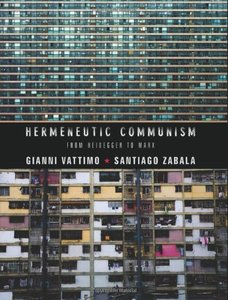
Hermeneutic Communism: From Heidegger to Marx - Gianni Vattimo & Santiago Zabala
Having lost much of its political clout and theoretical power, communism
no longer represents an appealing alternative to capitalism. In its
original Marxist formulation, communism promised an ideal of
development, but only through a logic of war, and while a number of
reformist governments still promote this ideology, their legitimacy has
steadily declined since the fall of the Berlin wall.
Separating communism from its metaphysical foundations, which include an abiding faith in the immutable laws of history and an almost holy conception of the proletariat, Gianni Vattimo and Santiago Zabala recast Marx's theories at a time when capitalism's metaphysical moorings -- in technology, empire, and industrialization -- are buckling. While Michael Hardt and Antonio Negri call for a return of the revolutionary left, Vattimo and Zabala fear this would lead only to more violence and failed political policy. Instead, they adopt an antifoundationalist stance drawn from the hermeneutic thought of Martin Heidegger, Jacques Derrida, and Richard Rorty.
Hermeneutic communism leaves aside the ideal of development and the general call for revolution; it relies on interpretation rather than truth and proves more flexible in different contexts. Hermeneutic communism motivates a resistance to capitalism's inequalities yet intervenes against violence and authoritarianism by emphasizing the interpretative nature of truth. Paralleling Vattimo and Zabala's well-known work on the weakening of religion, Hermeneutic Communism realizes the fully transformational, politically effective potential of Marxist thought.
Suscribirse a:
Entradas (Atom)